TRAUMA THERAPY FOR CHILDREN
in Hancock Park, Los Angeles
Healing trauma. Restoring safety. Helping kids be kids again.
Support for the caregivers helping them heal
Sometimes the signs of your child’s pain and fear are obvious. Sometimes it’s just a parent’s nagging concern.
You’re trying to understand behaviors that feel bigger than typical childhood struggles or you’ve noticed changes in your child that you can’t ignore anymore. They are not themselves anymore and you wonder where your sweet loving child is.
Maybe your child is clingy, fearful, or angry. Bedtime might have become difficult. There are nightmares, meltdowns, shutdowns, or emotional reactions that seem to come out of nowhere.
Or your child may seem distant or flat. They aren’t playing the way you expect a child should – they are not playing at all or when they do, their play lacks the childhood creative imagination. .
Maybe it feels like your child is falling off the timeline of developmental milestones and seems younger than their age, struggling with bedwetting, trouble sleeping alone, thumb-sucking, needing to be held constantly, and reluctance to go to school or even be separated from you.
Perhaps you’ve started noticing fears or attempts to avoid people or places or activities. They might have constant physical complaints like stomach aches and headaches.
For some families, these struggles appeared after a painful or frightening experience. For others — including fosterive, adoptive, or kinship families — these behaviors may have been present from the very beginning of the relationship.
You are wondering if something deeper is going on underneath the surface - is my child having difficulty because of that past trauma? Did something happen that I don’t know about?
As a parent, you may feel heartbroken, overwhelmed, and unsure how to help. You’ve tried comforting, reassuring, and staying patient, but nothing helps. And you are exhausted and feel guilty every time you lose it.
You may find yourself thinking:
“I know my child is hurting, but I don’t know how to help them feel safe again.”
Or maybe your child seems fine, but you are wondering how can they be okay after what they have been through.
Your family does not have to figure this out alone.
Helping children process trauma through connection, play, and safety.
Child trauma therapy can help you feel more confident that you are helping your child. Imagine feeling less alone and more sure that your child will be alright. Over time, you may begin to notice moments of relief - more playfulness, fewer intense meltdowns, increased confidence with separation, or a growing sense of ease in everyday routines. You may start hearing laughter again. Life at home can begin to feel calmer, more connected, and less overwhelming for both your child and your family.
Helping children feel safe enough to heal
Young children often cannot tell us directly what has hurt them. Instead, trauma tends to show up through their bodies, behaviors, emotions, and play. I can help you better understand what may be underneath your child’s behaviors and what they need in order to feel safer and more settled again.
I meet children where they are developmentally, often getting on the floor alongside them during play, art, games, storytelling, and other age-appropriate activities like sand tray that help them express feelings, process experiences, and build emotional regulation skills in ways that feel natural and safe. And while it may look like all fun and games, what we do will be using evidence-based techniques that have shown to be effective with children who have been impacted by trauma..
Our work together focuses on helping your child experience therapy as a consistent, supportive relationship where they can begin rebuilding trust, safety, confidence, and connection at their own pace.
However, healing does not happen in isolation. Caregiver involvement is an important part of the process, and therapy will also include helping you better understand trauma responses, strengthen connection with your child, and feel more confident supporting regulation and safety at home. Depending on your child’s needs, this may include parent sessions, regular check-ins, or joining parts of the therapy process together.
Therapy for child trauma can help:
You
Better understand what your child’s behaviors may be communicating
Create more safety, predictability, and calm at home
Your Child
Get back on track developmentally
Feel safe, settled, and more like themselves again
Express big emotions in healthier ways
Reduce fear, anxiety, meltdowns, or shutdowns
Re-engage in play, relationships, and everyday childhood experiences
Respond to emotional overwhelm with greater confidence
Learn how to stay grounded during meltdowns, shutdowns, or moments of distress
Strengthen connection and attachment with your child
faqs
Common questions about trauma therapy for children
-
Adult therapy relies mostly on talking. Young children don’t yet have the words, or the cognitive development, to describe what happened to them the way older children and adults can. Instead, they process and communicate difficult experiences through play, art, and imagination, so that is where trauma therapy with children happens.
Therapy also includes activities that help a child experience and practice being in, and shifting between, different levels of energy in their body, such as feeling revved up, calm, or shut down. These skills are hard to learn by talking, but easy to learn through doing.
Even play takes several forms:
Free, child-led play: The child chooses, and the therapist follows. It’s often where children show what they can’t say in words.
Pretend and storytelling play: Dolls, puppets, or figures let children work through big feelings at a safe distance, and practice new endings.
Games with structure: Board and card games build trust and give practice with turn-taking, frustration, and calming down.
Movement and body-based play: Bubbles, stretching, and fast/slow games help children notice what’s happening in their bodies and settle them.
If your child seems to be “just playing” in session, that is the work. Your child’s therapist is paying close attention to what the play shows, and guiding it so your child can heal at a pace that feels safe..
-
In addition to play therapy often used with children, there are several trauma-specific modalities that have been shown to be effective with children who have experienced trauma such as SMART, ARC, TF-CBT. There are also ways to adapt EMDR that are child appropriate. Even within pay therapy , a trauma-informed pay therapy can immediately see the difference between play that is helping a child move through the trauma and play that can be re-traumatizing because it is re-enacting the trauma in a loop. Same can be said about art therapy – a trauma specialist can more easily recognize not just the content, but the approach to drawing or other art making that has trauma themes.
-
child abuse, neglect, emotional and verbal abuse, sexual abuse, car accidents, fire, witnessing domestic violence.
-
Early in my career, I had two hours of child trauma specific training at Besel van der Kolk’s Trauma Center. In the 24 years since, over half of my clinical work has been with children. I am also a founding member of the National Child Traumatic Stress Network, a network of trauma specialty agencies/organizations across the nation. I was a co-author on a paper that defined complex trauma (the impact of childhood ongoing interpersonal trauma on children) and was a reviewer of various measures to assess trauma symptoms in children. I continue to participate in monthly meetings with experts in child trauma across the nation. I have presented at national and international conferences and trained hundreds of professionals regarding the impact of child trauma and the interventions that help.
-
Play therapy is not just playing board games. While those can be helpful when building rapport, assessing frustration tolerance (a common issue in trauma), and teaching specific skills, true play therapy uses a child’s natural use of imaginative play to work through problems, concerns, and fear. There are two main approaches: child-centered/non-directive (where child leads the play or directive (where the therapist offers prompts, introduces new characters, dialogue, or actions). In trauma play therapy, if a child is working through the trauma through play, the therapist doesn’t want to do much other than provide the correct stimuli and safe space to allow this to happen. But if the child seems stuck, the therapist introduces new characters, comments, or themes to see if the play can shift. Trauma play therapy can also include body-based play to teach the body that distress ends and teach it that it can have different levels of intensity of emotions and shift between these.
In somatic or body work - play can also be used to practice nervous system regulation - to teach the body how to calm, shift out of shutdown, switch states, experience different levels of emotions.
-
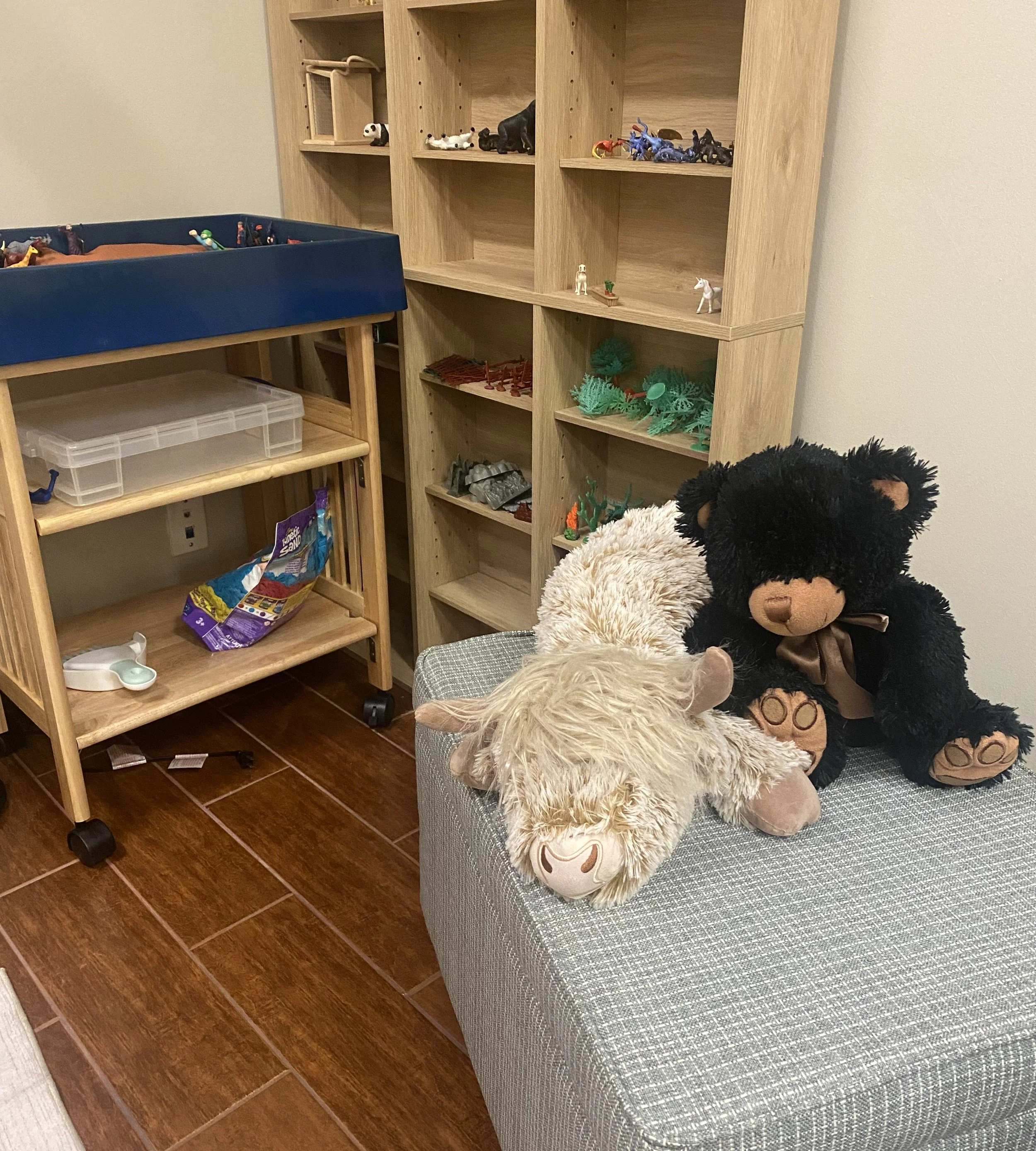
Sand tray therapy is a gentle, expressive approach that helps children communicate thoughts, feelings, and experiences that may be difficult to put into words. During a session, your child uses sand and miniature figures — such as people, animals, buildings, or natural objects — to create scenes or small “worlds” that reflect their inner experiences.
For many children, play is a more natural language than conversation. Through the sand tray, children can safely express worries, fears, confusion, anger, or difficult memories in a way that feels less overwhelming than talking directly about them. Sand tray is like creating a 3-dimensional picture book of their life and experiences.
As your child builds scenes in the sand, they may begin exploring emotions, acting out experiences, solving problems symbolically, or creating safety and protection within their world. The therapist may offer gentle prompts or carefully chosen figures to help support this process, especially when trauma or big emotions feel difficult to access.
Sand tray therapy can help children:
Express emotions they may not yet have words for
Process difficult or traumatic experiences
Feel safer and more understood
Develop emotional regulation and coping skills
Build confidence in expressing themselves
Sometimes parents or caregivers may also be invited into parts of the process to help strengthen connection, understanding, and communication.